2026 Work Programme of the German Council for Sustainable Development (RNE)
Foreword
The world, Europe and Germany are in a state of flux. Multiple crises and rapid economic, technological and societal developments are calling long-held certainties, systems and political decisions into question. At the same time, the rules‑based foundations of sustainable development are coming under pressure – and with them the commitment to a liveable future within planetary boundaries, as expressed in the goals of the UN’s 2030 Agenda. As a result, the pressure for reform and transformation is often greater than the willingness or ability of society, economy and politics to actively shape a future‑oriented transition. Simplistic, often backward‑looking promises of solutions are gaining influence and obscuring a fact‑based view of the path ahead.
Against this backdrop, the German Council for Sustainable Development (RNE), newly appointed at the beginning of 2026, sets out to sharpen precisely this perspective and to support the federal government in preparing and implementing sustainable, future‑oriented decisions. To this end, we intend to activate three levers:
- “A future-ready economy”: The Council will demonstrate that sustainability is not a cost factor to be minimised, but a driver of growth that links economic strength with ecological responsibility and social balance. Key building blocks in this regard include energy sovereignty, the mobilisation and leveraging of private capital, sustainable and long-term viable business models, and – not least – security and resilience.
- “Germany 2030plus”: The RNE aims to show how sustainability can serve as a compass guiding us towards a liveable future – not driven by wishful thinking, but grounded in realism, pragmatism and the flexibility required. In doing so, the RNE also seeks to contribute to a positive narrative of the future as an essential foundation for collective change.
- Action plan “Sustainability for a Modern and Future‑Ready Germany”: This plan is an implementation instrument adopted by the federal government for elements of the German Sustainable Development Strategy. It will be actively accompanied and supported by the Council.
We are convinced that sustainable development is both an opportunity and a necessity for a liveable future within planetary boundaries. As such, we will pursue the sustainability goals with both proven and innovative approaches.
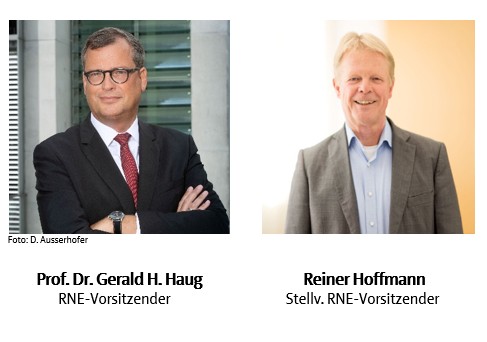
Prof. Dr. Gerald H. Haug, Chair and Reiner Hoffmann, Deputy Chair
How the RNE works
Basic principles
The RNE bases its work and external communication on the following principles:
Relevant and context-sensitive
Relevant advisory initiatives aim to influence concrete policy processes that matter for sustainable development in Germany and for the country’s role in Europe and the world – now and in the future. The Council’s recommendations are grounded in current scientific evidence. In the spirit of agenda‑setting, they draw attention to new or previously overlooked but important issues and developments, taking into account the current sustainability discourse and using communication tailored to specific audiences.
Solution- and impact-oriented
Solution‑oriented advisory work starts from concrete challenges and specific questions, offering targeted and actionable options to address them. In doing so, the RNE anticipates how political impact can be generated and how links to the UN Sustainable Development Goals (SDGs) can be established. The Council considers issues across all levels – local, state, federal, EU and international. Furthermore, its work always integrates ecological concerns, economic development and social policy dimensions.
Lived realities and acceptance
From its multi‑stakeholder perspective, the RNE develops clear and accessible recommendations that take diverse lived realities into account. It examines how sustainable transformation can be shaped effectively while recognising socio‑economic, regional and individual room for manoeuvre. The benchmarks for acceptance are fairness, effectiveness, individual benefit, the common good and simplicity.
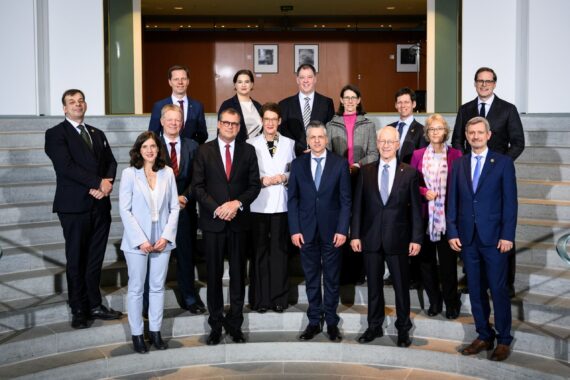
Constitutive meeting of the German Council for Sustainable Development (RNE) at the Federal Chancellery. Photo: Sandra Steins © Presse- und Informationsamt der Bundesregierung
The RNE’s focus topics for 2026
For 2026, our work programme defines two focus topics to be prioritised:
- A future-ready economy
- Germany 2030plus: Futures for a liveable and sustainable Germany
A strong economy that operates within market‑based and planetary boundaries, ensures fair income distribution and innovates to open up future markets is a central pillar of a future‑ready Germany, contributing significantly to security, resilience and social cohesion. At the same time, it provides the financial foundations of a functioning state – in particular for infrastructure investment, defence, education and social security systems. With this in mind, the RNE will focus on three areas in 2026:
- Energy sovereignty: affordable, stable and climate‑neutral energy supply
- Financing and framework conditions: capital for future‑oriented investments and favourable conditions for future industries and sustainable business models
- Security: as both a prerequisite for and an opportunity to advance sustainable development
Sustainability policy is future policy. The RNE will therefore develop scenarios for a liveable and sustainable Germany with a time horizon of 2030plus.
In addition to these priorities, the RNE accompanies ongoing policy processes and initiatives for which it provides continuous advisory support. These include:
- the further development of the German Sustainable Development Strategy (DNS), in particular the new action plan, as well as questions of sustainability governance;
- European sustainability policy;
- International sustainability policy, especially the SDGs and the post-2030 agenda;
- Sustainability at the local level.
1) A future-ready economy
What this is about: A future‑ready economy – market‑based, environmentally compatible, socially just and innovative – not only seizes opportunities in new markets, creates good jobs and fosters social cohesion. It also links economic dynamism with global responsibility, thereby laying the foundation for a liveable future. For this to succeed, capital must flow into future‑oriented innovations and industries, and sustainable business models must be viable and adaptable. Key building blocks of a future‑ready economy include, above all, energy sovereignty and security in a broader sense. The Council will initially focus its work on these topics in 2026:
- Future‑ready economy as an overarching goal: What framework is needed to steer innovation and investment towards sustainability?
- Energy security as a cornerstone: Without stable, affordable and clean energy, there can be no future‑ready economy.
- Security and sustainability as cross‑cutting issues: Security and resilience in the broadest sense are essential foundations for sustainable development.
Capital for future investments and strong foundations for sustainable business models
Germany is the world’s third‑largest economy and is regarded as an innovation leader in many fields. At the same time, its economic and innovative capacity is losing momentum, and Germany as an industrial location is falling structurally behind. The aim of the Council’s work in this area is to help shape framework conditions that keep system‑relevant industries in Germany and Europe, reduce dependencies, secure market leadership in key sectors and enable sustainable business models from and within Germany to succeed.
Transforming and modernising infrastructure, energy systems and buildings, decarbonising the economy and opening up future markets all require enormous financial resources that cannot be provided by public budgets alone. Incentives, regulation and risk‑mitigation instruments must therefore work together in such a way that investment strengthens Germany as a business location – as well as its municipalities and society – enhances future readiness, and makes innovative and sustainable business models viable.
Energy sovereignty: Affordable, stable and climate‑neutral energy supply
Energy sovereignty and energy security in the 21st century are not achieved through the use of fossil fuel reserves, but through a resilient, intelligent, renewable and European‑integrated energy system. The central challenge is to reconcile short‑term security of supply with long‑term climate neutrality and competitive costs. This requires a broader understanding of energy security and energy sovereignty, rather than a narrow focus on supply security alone. The aim is to rethink energy security under geopolitical pressure, identify crisis‑resilient policy instruments that avoid carbon lock‑in, and define the building blocks of a resilient, intelligent and cost‑efficient energy system. European integration, strategic autonomy and energy partnerships are considered key levers in this context.
Security as a prerequisite for – and an opportunity to advance – sustainable development
Investments in climate‑resilient infrastructure, digital sovereignty and civil protection not only enhance military capability but also strengthen societal resilience and ecological future readiness. A modern understanding of security requires a holistic perspective that, grounded in the liberal democratic order, integrates strategic, economic and societal dimensions.
The RNE can provide significant added value here as a multi‑stakeholder body. Its diversity of perspectives helps structure the public debate, make conflicting goals transparent and strengthen political decision‑making capacity in the interests of sustainable, future‑ready development. In the context of the current fiscal debate on the accompanying 1.5% security‑relevant investments as part of the 5% NATO target, there are particularly promising entry points for linking sustainability and security, as resilience, infrastructure and cyber‑security are explicitly highlighted in this discussion.
2) Germany 2030plus: Looking ahead
What this is about: In 2026, the RNE celebrates 25 years – of setting the agenda for policymakers, being a credible voice for future‑ready, sustainable and just development, and paving the way for a bright future for today’s and future generations.
The Council will use this anniversary as an opportunity to look forward. As a central strategic element, it will develop future scenarios for Germany 2030plus. These scenarios outline several plausible development pathways that capture potential trajectories and challenges for Germany beyond 2030. Building on this, the Council will formulate a preferred scenario – a positive vision of the future – that makes sustainability visible for what it truly is: the road to a liveable future.
The scenarios serve as a strategic compass for the Council throughout the entire period of its mandate. They make interdependencies between policy fields visible, help overcome siloed thinking and enable recommendations to be aligned not only with the present but with multiple possible futures – more robust, more forward‑looking, more adaptable. The preferred scenario provides a clear direction of travel; the additional scenarios open up corridors for action in case developments unfold differently than hoped, and show where common ground can be maintained even under conditions of uncertainty.
But the scenarios are also intended as an offer: to the federal government as a framework for mission‑oriented sustainability policy, and to parliament and civil society as an invitation to engage in dialogue about the future we want – and what it will take to achieve it.
Ongoing advisory work
International and European sustainability policy
More than ten years after the adoption of the 2030 Agenda, implementation of the SDGs is not on track. Despite some areas of progress, the multiple crises of recent years – combined with persistent funding gaps – have led to significant setbacks. This trend is further reinforced in today’s politically uncertain environment, marked by intensifying geopolitical rivalries and conflicts, shifting power dynamics, disregard for the rules‑based international order and a growing loss of legitimacy of the United Nations.
Moreover, efforts to sufficiently reform the international financial architecture have not borne fruit. Added to this is the growing distancing from the 2030 Agenda – or from individual SDGs – by some countries, most notably the United States. This affects not only the urgently needed acceleration of SDG delivery by 2030, but also the development of a post‑2030 framework, which will need to be negotiated between states in the coming years.
Against this difficult backdrop, the RNE can, during its 2026–2028 mandate period, advocate for continued ambitious implementation of the agreed SDGs, for stronger consideration of cross‑cutting issues and interdisciplinary collaboration (including spillover effects), and for enhanced support to the federal government in key UN‑level processes – particularly the HLPF (High-level Political Forum on Sustainable Development). It can also contribute its expertise and networks to shaping the post‑2030 agenda and to developing new international partnerships and cooperation mechanisms.
Alongside the international level, European policy plays a central role in shaping sustainability policy in Germany. Many of the most important environmental and climate policy frameworks are developed at EU level and set the parameters for national action. Common European regulations ensure that sustainability objectives are pursued across borders and that distortions of competition are avoided. In the new legislative term of the European Commission, it is proposing a Competitiveness Compass together with the Clean Industrial Deal as the core pillars of the EU’s economic and climate policy for the coming years.
The accompanying guidelines, regulations and delegated acts will be drafted and negotiated with the European Parliament and the Council of the EU over the coming months and years. The overarching objective is to make EU member states more competitive while continuing to set the course for the transition to a climate‑neutral and sustainable economy. As an influential EU member state, Germany plays an active role in shaping European sustainability policies.
Close coordination between the national and European levels is essential for effectively handling global challenges such as climate change, biodiversity loss and environmental pollution. The RNE monitors these processes and systematically integrates them into its policy advisory work. In addition, through its membership in networks such as the European Environment and Sustainable Development Advisory Council (EEAC) and the European Sustainable Development Network (ESDN), the RNE is well connected, able to leverage synergies and address relevant issues in greater depth.
The following selected policy processes serve to structure this area of work. The Council will decide at a later stage which topics to prioritise:
- International: UN80 reform process; reform of the international financial architecture/Financing for Development (FfD) process; acceleration of SDG implementation/HLPF reform; GSDR2027/Beyond 2030; and broader issues such as geopolitical conflicts and shifting power dynamics (keyword: “multipolarity” – new alliances), as well as potentially the interplay between international security/military build‑up and ODA (official development assistance).
- EU: For every topic addressed by the RNE, the European dimension will be taken into account and relevant EU processes will be referenced.
Local sustainability
Successful implementation of the international sustainability goals depends to a large extent on appropriate framework conditions for cities, municipalities and districts. According to the OECD, two‑thirds of the SDGs can only be achieved with the involvement of the local level. The German Institute of Urban Affairs even concludes that up to 74 percent of all SDG sub‑targets are directly relevant for German municipalities. Moreover, subnational actors are gaining importance in times of geopolitical tension and in the context of uncertain political majorities for ambitious sustainability policies. Strong vertical integration of sustainability policy – and suitable framework conditions for each level of government – holds significant potential for sustainable development.
The RNE works to boost the visibility of municipal contributions within the multi-level governance system and advises the federal government on promoting vertical coherence in German sustainability policy. The Council systematically integrates the municipal level into its policy advisory processes.
German sustainability governance, action plan and missions for a future‑ready Germany
The German Sustainable Development Strategy (DNS) is the steering instrument for sustainable development in Germany, guided by the 17 SDGs. To enhance its effectiveness and accelerate implementation, the DNS is to be further developed into an action plan with missions. The basis for this is the cabinet decision of 5 November 2025, “Sustainability for a Modern and Future‑Ready Germany”. The Council will accompany this process and develop cross‑cutting contributions on governance and mission‑driven policy. Through its expert advice on selected priority topics, it will also help amplify the impact‑orientation and reinforce the implementation focus of the overall strategy.
Projects and networks
In line with the Council’s expanded mandate, it promotes societal dialogue on sustainable development at national and international level through a range of projects. These projects are designed to anchor awareness of sustainability effectively across society and the economy. They also strengthen exchange within networks at the local, national and international levels.
The RNE’s projects and supported networks additionally provide an important lever for the Council’s political advisory work. They increase the visibility of Council statements, stimulate discourse and expert exchange, and allow recommendations to be tested against practical experience and quality standards. Close cooperation between the projects and the RNE makes it possible to gather diverse perspectives more systematically – for example, to feed them into Council statements or to draw conclusions that inform the RNE’s own positions.
Networking across and within regions
The German Sustainability Action Days (DAN) aim to highlight sustainability engagement across Germany and to encourage more people to act sustainably.

The RNE is a member of the European Environment and Sustainable Development Advisory Councils Network (EEAC Network), which promotes sustainable development in Europe and facilitates the exchange of best practices among the participating national and regional advisory bodies.
The RNE is an associate member of the European Sustainable Development Network (ESDN), a network of decision‑makers, experts and organisations from across Europe dedicated to promoting sustainable development and supporting the implementation of the UN Sustainable Development Goals (SDGs).
Focus on the economy:
The Climate Governance Initiative (CGI) – Chapter Germany (together with the European School of Management and Technology (ESMT) Berlin and Board Academy e. V.) aims to support supervisory board members as their companies transition to climate neutrality and sustainability.
Since 2011, the German Sustainability Code (DNK) has been developed as a transparency standard for corporate sustainability reporting. Since 2025, the DNK has offered comprehensive support services that significantly facilitate sustainability reporting for companies. It is aimed at companies that are directly or indirectly subject to reporting requirements under the Corporate Sustainability Reporting Directive (CSRD), as well as companies reporting voluntarily using the Voluntary Sustainability Reporting Standard for SMEs (VSME).
Focus on municipalities:
The RNE Local Sustainability Reporting Framework (BNK) helps local authorities in Germany make their progress on sustainable development measurable, thus giving them greater control.
The “Sustainable City” dialogue promotes the regular exchange of ideas between mayors on sustainable urban development, while at the same time enabling local impetus towards a sustainable federal policy.