RNE members Franziska Tannenberger and Mark Lawrence were part of the German delegation at COP30 in Brazil. Here they discuss the possibilities of achieving the climate goals and why the subject of peatlands plays such an important role.
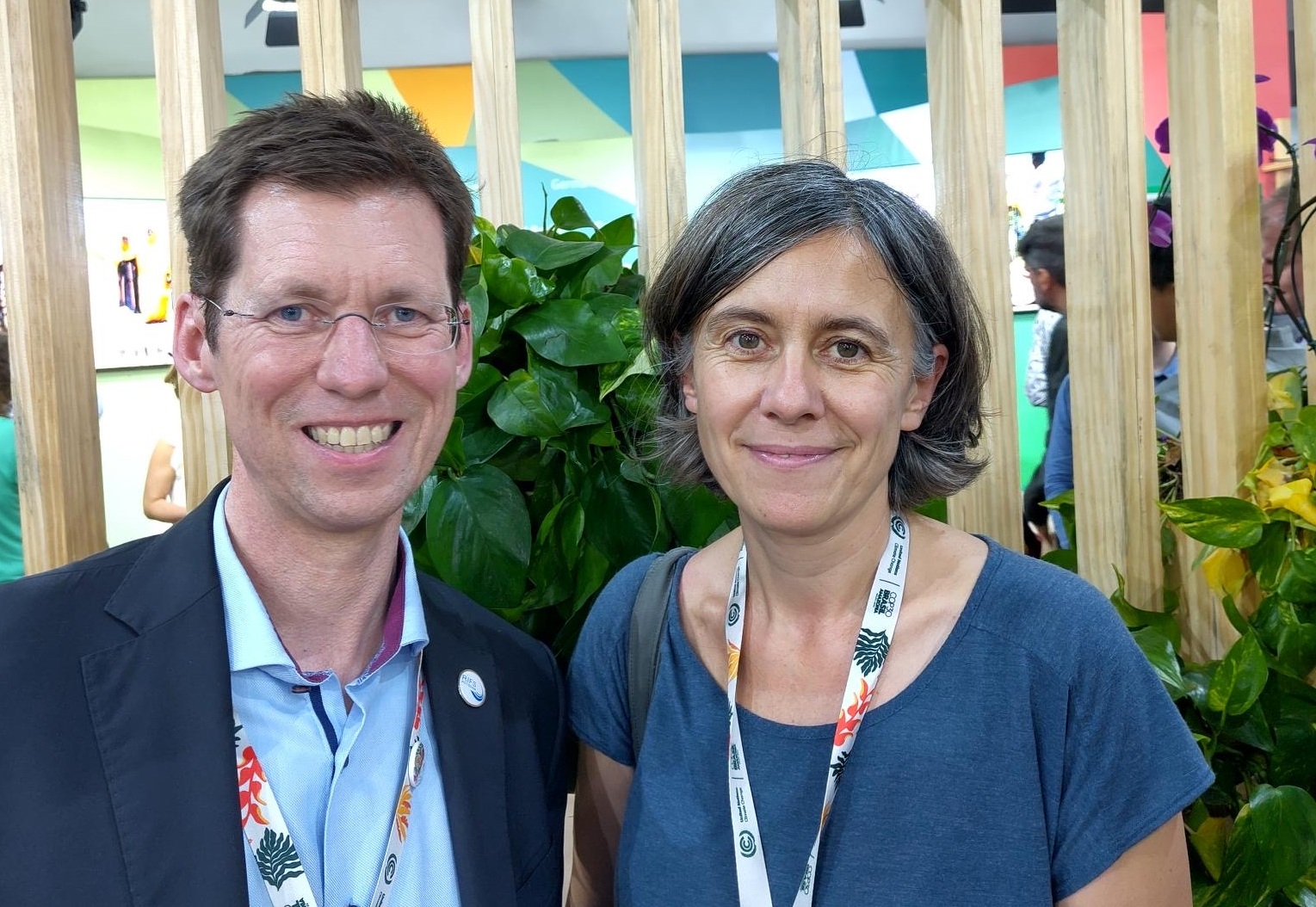
RNE members Franziska Tannenberger and Mark Lawrence were part of the German delegation at COP30 in Brazil. Photo: RNE
What is your evaluation of COP30?
Dr Franziska Tannenberger: It was definitely a success, but not as big a result as we would have wanted or needed. But given the current geopolitical situation with the USA, which didn’t even send a delegation, and with Saudi Arabia, which seems more intent on inhibiting climate action than promoting it, it is clearly a success that the negotiations took place at all and the community of states delivered an outcome.
Prof. Dr Mark G. Lawrence: We showed that, even in the current geopolitical climate, multilateralism is still alive and well. Even if there is still a lot to be desired, there is also some good news: thanks to the COP format, the world is now on a much less harmful climate trajectory than it was 10-20 years ago. That said, the currently predicted consequences of climate change will still mean a severe to catastrophic impact for billions of people. And that is precisely why we must not budge from our goals, even if others are not living up to their climate responsibilities. Germany has consistently shown up at the COP30 negotiations in a leading role. That’s something we can be proud of – and we can support this process further in terms of science and policy advice.
For both of you, this wasn’t your first time as part of the German delegations at the World Climate Conference. How would you rank the atmosphere, the diversity of interests?
Lawrence: Unlike at the last three COPs, this time the host was not an authoritarian regime: civil society, including activists, was noticeably more present at the conference, also in accompanying activities. At the same time, some of the participants, as an Indigenous person told me on the very first day, felt they were being used as a fig leaf – instead of really being heard in the negotiations. Even so, there was a respectful exchange between many different groups, which really listened to each other. That’s something that I as a scientist witnessed personally in numerous discussions with policymakers, activists, young people and representatives of Indigenous peoples. As a member of the Interfaith Liaison Committee of the UNFCCC, I also have a certain “insider” perspective on such conversations at the COPs. For example, one of the leading religious climate protection organisations expressed their deep appreciation for Germany’s support for the Colombian initiative on better integration of climate, biodiversity and land. It’s heartening to see that such efforts are noticed and that a broad, interregional dynamic can develop around them.
Tannenberger: My impression was that the delegation worked very well together as “Team Germany”. Our neighbouring countries don’t care which department individual positions and activities come from – perhaps this external perspective also helps us sometimes to represent the shared goals more strongly, such as exiting fossil fuels.
COPs are not just negotiating spaces, but also places for informal exchange. What role do you think the informal conversations, side events and chance encounters played?
Tannenberger: In our capacity as RNE members, it was especially important and effective for us to be part of the delegation. That began with the morning briefings, where you are deluged with information, and it continues with informal discussions. This requires suitable locations – the German pavilion was one of them: you could meet delegates there and, as it were, casually make people aware of scientific findings – and you would notice that they took them on board.
Lawrence: As part of the German delegation, we have valuable opportunities open to us, and as such we also bear a great deal of responsibility. Wherever we were – whether in the plenary hall, in strategic discussions with politicians, at side events or in committee sessions – we were committed to presenting a good impression of the German delegation and pointing out what Germany has to offer: its scientific excellence, also in the form of so-called co-creative engagement together with activists and Indigenous and religious groups.
The event location of Belém lies in the middle of one of the world’s most important natural carbon sinks. Did you get the impression that the geographical proximity to the Amazon changed the political priorities of the negotiators or their awareness of the problems?
Tannenberger: It’s bound to have had a certain effect. But on the goal of agreeing a roadmap against deforestation, they came up short. As a scientist whose research focuses on peatlands, I also notice that, when we talk about carbon sinks, the vast majority of people think of forests. But around the world, considerably more carbon is stored in peatlands than in forests – even if forests cover ten times the amount of land. What’s more, the peatlands that have been drained by people currently account for four percent of global emissions. But at COP30 there were no more than a dozen experts on the subject of peatlands. The ratio is off balance. Perhaps that’s down to the invisibility of the soils. With emissions from peatlands, you don’t see smoke rising from chimneys – they are virtually invisible to us.
As an expert primarily in nature-based solutions and peatland protection, what key concerns did you take with you?
Tanneberger: My main goal is to create more awareness and concrete action around peatlands. Even though they are not usually mentioned directly – they can play a key role in the NDCs, the nationally determined contributions, which outline each country’s commitments to reduce emissions. Stopping the drainage of peatlands leads to an immediate stop in the release of CO2. For that to happen, we need to get talking and see what knowledge is available where. Uganda, for example, is a pioneer and already includes peatlands in its NDCs, as does Mongolia. That is not a given. And it’s also about reporting the emissions. In the EU, around 60-100 megatons of CO2-equivalent greenhouse gas emissions a year are not reported, because maps or data are out of date. We were just able to show this in a study. If the emissions do not appear there, then there is no adequate political action.
Brazil has enormous carbon reservoirs (the Amazon, large wetlands). To what extent do the results of the negotiations reflect the importance of such nature-based solutions?
Tanneberger: One example would be Brazil, which is the tropical country with the largest peatland area in the world. I had the opportunity to speak to researchers from Brazil about natural climate protection – which leads a niche existence, even though it offers so many co-benefits. We have a biodiversity crisis, we have increasing scarcity of water, we need sustainable economic systems for our soils. The peatlands are great for bringing all this together, for example by producing building materials made from moorland plants that grow in the wet, climate-friendly peat bogs. In that sense I’ve noticed that the subject does arouse interest, and that we in Germany have a lot we can pass on.
In any case, it was a very worthwhile week for the issue: we got global peatland protection onto the Action Agenda, i.e. the framework for implementing the climate goals. For the first time, we now have global targets for protecting peatlands with the Peatland Breakthrough.
Realistically, the 1.5°C target is no longer achievable. What could the measures agreed at COP30 still achieve? What gaps do you think are especially critical from a climate research perspective?
Lawrence: From a physical point of view, it would most probably still be possible to meet the 1.5-degree target. However, it would be incredibly difficult to really put that into practice. Already in 2013, the IPCC showed that the global average temperature would remain more or less constant if global CO2 emissions were stopped suddenly or within a few years. As global warming was already around 1.5°C in the last few years, global CO2 emissions would have to be completely stopped practically overnight in order to reach this target. Societally, this is of course pretty unrealistic – sadly.
That’s why, we must first of all recognise that every additional temperature rise is putting society in a new danger zone. It’s not about protecting the climate from people, but about protecting people from the effects of climate change. To achieve this, we have to reduce greenhouse gas emissions, especially from CO2 and methane, as quickly as possible.
And what about carbon dioxide removal (CDR)? Won’t that save us? It’s already playing an increasing role in climate negotiations. What guardrails are important from a scientific perspective to promote CDR responsibly and in line with clear reduction paths?
Lawrence: There are numerous, sometimes quite fanciful ideas as to how CDR could help us reach our climate targets. But in the actual negotiations, CDR is not playing a major role yet – which is a good thing, because in the short term we mustn’t rely on CDR to pursue the climate goals of the Paris Agreement.
Nor should we implicate unrealistic plans for this in the achievement of net zero, either explicitly or implicitly. Often it is hoped, or even assumed, that technological developments will make it possible to remove significant quantities of CO2 from the atmosphere already by 2040 or 2045 as part of the plans for climate neutrality. But usually this doesn’t take into account the enormous additional demand for energy, resources and new infrastructures for CDR that would be necessary on a climate-relevant scale, resources that should ideally be concentrated on the expansion of renewable energies and other reduction measures.
According to our studies, the necessary technologies and additional capacities for the removal of climate-relevant quantities of CO2 with CDR will only be available in the second half of the century. However, it is still crucial to press ahead with research and development in the field of CDR now, to ensure that CDR can be implemented in the medium term.
What would be three priority measures for the next five years that would make the greatest difference from a scientific perspective?
Lawrence: First of all, strengthening diplomacy and mitigating conflicts worldwide are hugely important. Because as well as the terrible impacts for people locally, they also negatively affect progress on climate change.
Secondly, at the same time we have to drive renewable energies and accelerate the exit from fossil fuels. Currently, renewable energies are often seen only as a supplement to fossil fuels.
And thirdly, it is also essential that we develop positive narratives around climate protection. If the public embraces climate action as an opportunity, then we have taken a big step forward. Basically, it’s about working together and not against each other towards the common goal, in this case limiting climate change and protecting people against its impacts. Only if we pool our strengths and pull together will we achieve vital progress on climate protection and thus create a counterbalance to purely profit-driven, populist and nationalist interests. But it is also clear that we still have a lot to do.